Friday, September 16, 2016

The Alt-Right, Free Speech, and Trump

Over the last couple of months, there has been renewed focus on the alt-right movement and what they actually believe in.  Unfortunately, this also gives these assholes a media platform to pretend that they are anything but the white supremacists that they are, so I want to take this opportunity to punch them in nethers and bring them down a notch, as it were.

First off, I just want to make something clear: the alt-right isn't actually a thing. This whole idea of them being a "new" twist on conservatism or a legitimate alternative to mainstream ideas is, in technical terms, bullshit. They are just the latest iteration of white supremacy and antisemitism that stretches back to The John Birch Society, Father Coughlin, and the Klan. Their idea that race is an actual thing with a hierarchy that white people sit at the top is an idea that puts them in league with well, every popular European nation and American public thinker up until, oh, 50 years ago.  That's not even mentioning their ideas on the roles of women and gay people, or who should be allowed to vote. These guys sat and had a good long think to come up with original ideas to introduce to the body politic and came up with things that have been common practice the world over for thousands of years. We should all be so gifted.

But the alt-right wouldn't be a regressive right-wing movement unless they had some story about how they're the actual victims here, and that's where Milo Yiannopoulos comes in. In July, Milo was banned from Twitter after he bragged about inciting and encouraging the users who were bombarding Leslie Jones with racist and sexist messages and images. Milo, predictably, cried foul soon afterward, saying that Twitter was censoring him and infringing on his right to free speech by not letting him be a complete dickbag for kicks. I know it's becoming something of an internet cliche, but seriously, anytime people complain about their free speech being violated by a private actor, just refer to this xkcd comic:
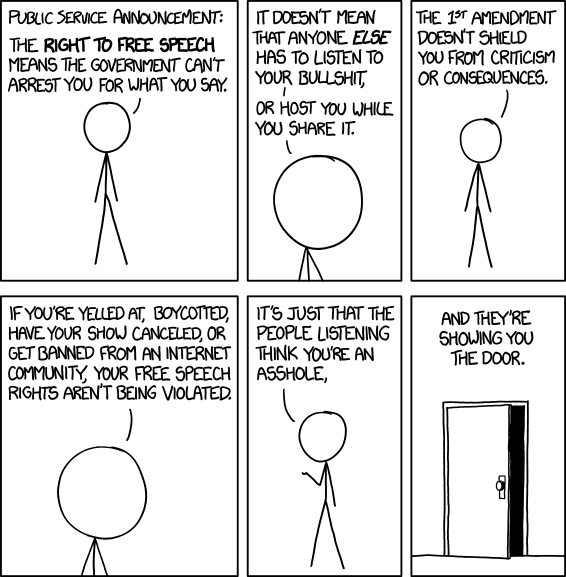
Free Speech


What's most galling about Milo and his ilk bitching and moaning literally every fucking time some tells them to go be worthless somewhere else, they always try to act like they are, somehow, being victimized. 

If you're going to be political provocateurs, at least try to have integrity when the push back comes. 

I mean, if you're going to devout all your time and energy- and really build your entire philosophy around- the idea that all of modern society is corrupt, weak, and pussified, than when you get shown the door by that culture because they're sick of listening to you, don't be a pussy in return. No one is stopping Milo from going on, at length, about how he's been unfairly censored and maltreated by the vile liberal conspiracy that is our culture. Shit, he was on CNBC last week, trying pass off the Alt-Right as anything other than white supremacy that swapped their sheets for suits a day before other Alt-Right leaders held a press conference that involved a dude saying the best future for America is making it an all-white country.

To be fair, it's not like Milo is going out and saying this bullshit because he wants people to not think of his ilk as horrible shitbags. No, he does it so the people that already buy what he's selling stay loyal and committed. See, if you bought into an ideology that's basically bigot bingo, you may eventually examine why you're being ostracized and figure out that hey, those are shitty beliefs and leave them behind. 

Since any awakening of common decency would completely destroy the alt-right's customer base, they create this narrative of victimization so when society tells them to go fuck off to the racist fever swamps they came from, it's not because they're the new Nazi's, no, it's because all those Social Justice Warriors just can't handle anyone coming in to tell people THE TRUTH!!! about how they've destroyed the world. Creating this narrative of victimization essentially guarantees that the adherents of this bullshit will double their support and effectively shut out any criticism or honesty about what their beliefs actually are because anyone who doesn't agree with their principles is either one of (((them))) or one of (((their))) useful idiot sheeple. That this whole tactic is based on the victimization culture the alt-right is so fond of accusing practically everyone of exploiting is an irony that, of course, goes completely over their heads.

Here's the thing: when people collectively decide what is and what is not acceptable to say in public discourse that's culture, nothing else. The 1st amendment was only meant to protect speech from government prohibition, it does nothing to protect you from other people saying "Shut the fuck up, already." Yes, cultural censorship can go horribly wrong and be misguided, but kicking these dregs back to the fringe isn't a mistake or something to cry over.  

So, the natural question is why do these people suddenly feel like they can say these things in the light of day and get a cheering crowd? The answer is pretty easy: it's because of Donald Trump. Now, I don't think Trump is actually a white supremacist or neo-Nazi like the idiots that cheer him on, mainly because having a political ideology requires you to think of the world as something larger than yourself, which I think he is literally incapable of doing. Trump's only real skill is realizing when there's a marketing opportunity afoot; so he spoke to those white, disaffected voters, people who felt like they were left behind because, in large part, as uneducated, poor, white people that is the bedrock of his base, they were. In response, they turned to a set of beliefs that was actively hostile to the culture they saw as demeaning and humiliating to them.

But what Trump is doing is courting and establishing a movement that, the longer it goes on, becomes more and more toxic. And the more he gets a free pass from journalists like Matt Lauer, or gets petted like a Chia Pet on Jimmy Fallon, the more he looks like just another politician saying outrageous things to get elected and the more the alt-right gets legitimized and accepted in mainstream culture. 

This is a fundamentally dangerous thing, because it means that when the next election rolls around, these fascists and Klan members and neo-Nazi's will be treated as a normal, acceptable part of American culture. The polls are close, but I still believe Clinton will win. It'll be by the skin-of-her-teeth, but she'll win. And since Trump is already laying the groundwork for saying that the only way he loses is if the election is rigged, his supporters aren't going to accept it. So they'll spend the next four years regrouping, reforming, crafting their brand so they can take another run at Hillary.  

Because that is what's going to happen, because Trump isn't an anomaly for the Republicans, he's their prototype. So tell me, in a world where Hillary is barely clinging to a national lead against the biggest piece of shit to run for President, what do you think her chances are when someone in a better suit, better hair, and can speak in complete sentences espouses the same shit Trump is, but takes a six point lead? Because the worst thing about this whole Trump business and the alt-right is sooner rather than later, they're going to be the mainstream conservatives they're lambasting now, and then, well, I guess we'll just have to find somewhere else to be, won't we?

Monday, September 12, 2016

Lather, Rinse, Repeat

I remember I was late for school, as usual.  My mom is quite easily the worst person to ask to get you anywhere on time, and always has been.  We had watched the footage of the towers being hit and burning on the edge of her bed, me wondering if I would get to stay home like when the Columbine shootings had happened three years earlier.  But, my brother was already at school, so reluctantly, she took me to the car and dropped me off.  Walking through the halls, all the doors were open, no one was giving a lecture, all eyes on the T.V's and the smoldering buildings, the cameras catching people leaping to their deaths to escape the fire and trying to lessen the blow by cutting back to the anchors, the impact written over their faces that didn't have the luxury of being to look away from the feed.

And then the towers fell.  And as they crumbled everyone was trying to grapple with the new world that was taking shape around them.  I imagine it must have been harder for my teachers than it was for us.  They had all lived through the Cold War under the constant threat of a nuclear annihilation via the U.S.S.R., but they had also seen that great enemy crumble.  The wolves had been at the door, but America had beaten them back, free to bask in a world where it reigned supreme above and beyond anything that could threaten it.  I wonder if, after the horror, they felt a sense of comfort in the old habit of being afraid of an evil out of the East lurking in the dark, waiting to strike.

Mostly I remember wanting vengeance, we had been hurt, and the world would suffer for it.  And holy shit did that come to pass.  The war in Afghanistan was met with a bloodthirsty glee, a nation ecstatic to bring down death and destruction on a country who's leaders had harbored Bin Laden and other al-Qaeda personnel.  Did it matter that the actual civilians could've cared less for any of the jihadi movements and wanted nothing to do with them?  Fuck no.  They were going to die in the cross fire and we didn't care, because we wanted to prove a point; that however many Americans you kill, we can kill yours ten times over.  A hundred, even, if we feel like exercising.  To date, there are an estimated 31,000 civilian deaths as a result of the war.  So, point taken, I guess.

But this being America, we always have to go bigger.  The civilian death toll from the Iraq War varies based on who's doing the counting, but the range goes from 165,000 on the low end to 1.3 million.  To put that in perspective, that's a 9/11 every day, for either 55 or 433 days straight.  And then there are the drone wars which range from 462-1,459.  But whenever these numbers are pointed out as the enduring cause and motivation for terrorism, the usual response is "Well, we didn't mean to kill those people.  So they don't count."  There are no safety switches on bombs or bullets so that only kill who you want or mean to kill.  Whether by intent or mistake, the dead are still dead.  And a society that refuses to own up to its responsibility in making the dead doesn't have any moral high ground to stand on when it seeks to avenge its own.

Every year we say "Never Forget", every year we seek out new places to bomb and wreck more devastation for longer periods of time on people who had nothing to do with events on one terrible day that's over a decade gone.  The most enduring, and frightening, lesson that 9/11 taught us is that we are as just a part of the world as everyone else.  For a country that has been so war-happy over the last century, we've never actually had to bear any of the costs of the those wars on our own soil.  We've never had to worry checking our farms for undetonated artillery shells or sweeping open fields for landmines.  We've never had to to rebuild our cities after years of air raids and infantry battles.  We'd never been really scarred before 9/11, and the idea that even a fraction of the violence we send out to the world could find its way back home is still, to this day, the most terrifying thing anyone can think of.

I keep waiting for people to realize that letting this fear of an attack from anywhere by anyone at anytime is toxic, that it's deforming who we are as a people.  I keep waiting for people to realize that we're better than this, that choosing to live this way is for fools and cowards.  But every year I see us languish over our damage and then use it to justify the deaths of so many more without considering the consequences and it hits home that no, actually, we're not.

Thursday, September 8, 2016

No More Pretending

One of the more interesting things to happen over this election cycle is to see how many liberal pundits don't actually care about liberal causes or principles.  After the 2010 Citizens United decision, the idea that money is an inherently corrupting force in politics was a standard thing.  Obama alluded to it in his State of the Union address the following year, and with the rise and popularity of Elizabeth Warren and Sherrod Brown, the party had enough capital to stake out a position where it stood against the free flow of money and corruption and wanted to clean politics up.  But then Hillary Clinton runs for President on the backs of a lot of dark money fundraising and well, suddenly, who's to say that campaign donations are a bad thing?  Surely she's only getting that money because all those industries think she's the better qualified candidate, right?  They certainly don't expect anything in return for those donations, oh no.

Leading the way in abandoning policy positions and goals because they make Clinton look bad,has been Vox, Ezra Klien's pet project originally launched with the mission to provide deep-dive policy wonk articles but written so people would actually find those discussions interesting.  Whether or not it ever really was that is a matter for another time, but for now, let's just say the site as done an admirable job doing ideological cover for Clinton in painting every criticism of her from the left as being just like when Republicans shout "Benghazi!" or "Vince Foster" when they drag out the classics. So now that the idea of an open and transparent government via the Freedom of Information Act is causing trouble for Hillary Clinton, it's Matthew Yglesias to the rescue in his Tuesday "Against Transparency" piece.

The thesis of the piece is basically that emails shouldn't be held to the same record keeping standards or FOIA requests as paper documents because they're more informal and that the eventual release of those communication records will make people speak less in policy or conversational terms but more in "how is this gonna look on Politico five years from now" terms.  It's an incredibly stupid and painful article to read, but I do have to give points for Yglesias to actually force this nonsense out into the world.  It's commitment, if nothing else.

It is entertaining though, to imagine Yglesias flail about as he tries to find some way or rhetorical trick to make it seem like people can't communicate in their emails.  He seriously spends the majority of the piece trying to spin this tale of a government that is hapless to do anything official because if they use email those emails will someday be *gasp* read by the people.  It seems strangely odd that Ygelsias thinks that for a government to be more effective, it has to actively hide more of its activities from the people they represent.  Yglesias even makes the argument at one point that since emails are subject to archival and public release like paper memos, that the people in the emails will be less interested in discussing the issues of the day in real terms and more concerned with how they'll look in history or the political tabloids.

The hysterics Yglesias works himself into while discussing these things is, like I said, entertaining, but so, so, pitiful.  For one thing, if people in say, the State Department, want to have a in depth discussion about their own personal and their policy goals over email, they can.  Those emails will more likely than not be slapped with some level of classification and those emails aren't released until the executive branch deems it appropriate.  So, absent a leak or a hack those emails aren't coming out in any immediate future, so Yglesias can stop worrying about people's hurt feelings when someone says something mean about them when discussing who to assign a specific project.

Also, if anyone wants to avoid those records, they can just talk to each other, in person.  Yglesias knows this, because he makes a big to-do over how people will end up having face-to-face meetings to talk about anything important to scuttle disclosure laws.  Look, I'm all for transparency, but I realize that some conversations need to had without people taking notes so that you can figure out what those positions will be when you actually do go on the record.  That's fine, a bit underhanded when abused, sure, but there has to be a give and a get.  But the Yglesias speaks as if this isn't a practice that's already happening, he makes his point in such dire bad-moon-on-the-rise language that I honestly wonder what he ever did that justified the position he has as a respected and deep thinker.

The other argument Yglesias makes is trying to draw a distinction between what he sees as useful and non-useful disclosures.  He says that things like the Bureau of Labor Statistics and other government agencies who collect and release statistical work are the good kinds of disclosures because they keep the country informed, basically, of how things are going.  he even makes an interesting suggestion about letting the IRS and BLS share data so the latter can have a better data set about what pay goes with what jobs in all fields.  Officials emails though, he claims, are in no way a part of the public interest like those statistics so they should just be locked away forever where no one can see them.  That anyone can make this argument in the era of Edward Snowden and Chelsea Manning is incredible.  Knowing what the government is doing and who they are doing that business with is always, pretty much by definition, going to serve the public interest.  That a journalist can't see that, or, more accurately, is working to obfuscate that point has decided that the only thing that matters is making sure powerful people will want to pat him on the head and call him a good boy so he can get a good treat.

Look, I get it.  The Clinton email story won't go away.  There aren't any bombshells, no bribes, no nothing.  All they reveal is that Clinton, like every other politician, gives face time and access to people who give them lots of money.  The Sun set in the West today, film at 11.  So, because of that, the liberal punditry is desperately trying to get people to move on to something, anything else, and they keep failing to do so.  What Ygelsias and his ilk still can't seem to understand that a political system that doesn't blink at donors making donations to private foundations run by political figures while they're out of office than leverage those same donations for access when they go back in to office is a shitty system.   People's problem isn't that someone handed the Clintons a bag of money for the foundation in exchange for whatever they wanted.  People's concern is that, when push comes to shove, who does the government actually work for?  Who's interest will it pursue?  And the answer to that question basically comes down to who is in the room while you're making those decisions.  The main reason the email story won't go away is because none of hagiographers have ever dealt with the core issue that bothers people about them; sure, they don't reveal anything criminal, but they do confirm that if you're rich and give enough money to people, that's going to open a door and give you a chance to be heard above the din of well, everyone else.

Maybe, in later years, people can look back on this time and mark this election as the beginning of the end for our current era of journalism, one where the media failed to pass itself off s objective and intelligent while acting as the propaganda arms of  one or the other political party.  At least, I hope that happens, because if we have to live with disgraces like Yglesias for much longer and they're still seen as credible, I think we'll forget what actual journalism or just intelligent, principled, thought in general is supposed to even look like.

Saturday, September 3, 2016

Hell or High Water Review

Hell or High Water is the second movie from Sicario scribe Taylor Sheridan, directed by David McKenzie, that follows bank robber brothers Toby and Tanner Howard (Chris Pine and Ben Foster, respectively) as they're hunted by Texas Rangers Marcus Hamilton and Alberto Parker (Jeff Bridges and Gil Birmingham).  Like Sicario before it, this movie has an exaggerated sense of realism that grounds the story has the stakes climb higher. Unlike its predecessor though, this film never quite achieves the level of tension as the hunt goes on and it never feels like the brothers are in any danger of being caught in a ever tightening noose.

That's not to say that the movie is not without it's strong points.  Foster and Pine have a very loose chemistry of brothers who are getting along for the moment  by managing the tension of past injuries and slights that keep bubbling up to surface and have to be kept in check at all times.  Bridges and Birmingham also have a loose, steady rapport as the Rangers hunting the brothers down.  The movie is also gorgeous to look at, with McKenzie following the lead of Breaking Bad and No Country for Old Men in letting the wide, desolate desert landscapes become a character in and of themselves.  The film also does a great job of making each podunk town scattered across West Texas as places whose time has come and gone, with the only thing left for them to do is rot back into the land they sprang from.

Another vastly appreciated tack this movie takes is that it doesn't treat itself has "important" or drag out a soapbox to berate the audience with its message.  Yes, there is a running theme of how theft by individuals and institutions is a cyclical thing that's playing itself out yet again, but aside from pretty much three lines from Parker that explicitly lay this out, the movie doesn't dwell on it longer than it has to.

But, there are problems.  Mainly, the pacing never really takes off.  For much of the movie, we're  just cruising along watching the brothers robbery scheme go of without any kind of hitch.  Which leads to the second problem of the movie, the investigation never seems like an actual threat, so for all intents and purposes when we're watching the Ranger sections of the movie it just seems like we're watching two people just kinda putter around hoping to stumble on the people they're chasing.  At no point in the movie do the Howard brothers even mention that any law enforcement could be investigating them, the very thought seems so meaningless and inconsequential that neither brother, even first time criminal Toby, can't bring himself to worry about it.  Thing is though, if this a cops and robbers movie, than the robbers have to at least, in theory, consider the cops a threat.  Basically, if the cops aren't seen as dangerous to their in-movie enemies, the audience isn't going to have much a reason to worry about them, either.

The lackadaisical pacing also hurts the movie by making the turn to the climax really telegraphed and mostly ineffective.  Both partnerships make their move to the final robbery independently and pretty much on a lark on both sides.  Also since this last robbery has "this is the one that goes bad" written all over it, so when things do go sideways, there's no real hell breaks loose moment or escalation of, well, anything.  Everything just happens, and then the movie pretty much ends.

Qualms aside though, this is a pretty solid movie.  The directing isn't anything spectacular, but it gets the job done; all the actors turn in good, subtle performances, and the movie isn't filled with pointless scenes to pad itself out or dialogue trying to make itself sound important.  In the end, it's good but not great, which at this point in the summer, pretty much makes it the best thing around.

Grade: B

Thursday, August 25, 2016

Deromanticising the Stone: Part Two

A few days ago, I took a look at a few of Gary Johnson's platform issues to take the sheen off his candidacy a bit. Now, it's Jill Stein's turn. Before we do that, I want to address the vaccines thing first. No, she didn't say vaccines cause autism or any of that nonsense, she said that pharmaceutical companies shouldn't be involved in regulating a product they stand to profit from. I understand the point, but vaccines are one of the safest medical technologies we've ever invented, so it's still not a very good one. Also, that same line of attack is one commonly used by actual anti-vaxxers, so using it and acting like it's a respectable point to discuss just gives those idiots a foothold of credibility in a conversation they don't belong in, so if you're attacking her statement for that, then by all means, do so.

With that out of the way, let's take a look at Stein' policy platform. Overall, I agree with most of it, and think the world would be better off if large parts of it were implemented. The glaring, almost fatal flaw of the whole thing though, is that as President, Jill Stein would have almost no power to actually do anything in her platform.

Take her economic initiatives.  
She talks about setting up a $15/hr minimum wage, of breaking up Too Big To Fail banks and democratizing the Federal Reserve, along with other niceties like equal pay, paid sick leave, and stronger worker protections. If you haven't spotted the common thread between these things, it's they all require new legislation from Congress to actually become things that happen in the real world. And I don't know if you've been paying attention or not, but Congress hasn't exactly been known for getting, well, anything done for the last six years. How  President Stein would get these rather controversial measures through a hostile Congress (because, make no mistake, the Democrats are just as hostile to those measures as Republicans) is left up to voter's imaginations, since Stein declines to actually recognize this as a problem on her website.

This pattern pretty much is her platform. On health, she wants to ensure Medicare for all in a country where the health care system devised by the very free market Heritage Foundation had trouble passing and has been characterized from day one as a government takeover of healthcare even though it is very much not. Also, that's still something Congress has to do. There's her Green Deal employment program, which basically seeks to retrofit the country's infrastructure to renewable energy grids by 2030. To do this, the funds would either have to come from new taxes or deficit spending and she would need a bill dedicating those funds to these projects. Which, again, Congress.

A lot of the projects and goals included in the platform are good ones, and even if we didn't achieve them, the results we would get from working on them would vastly improve our country. But there's a fundamental dishonesty at the bottom of this that undoes the lofty aspirations. Because, in truth, this is a legislative platform, not an executive one.  President Stein would have as much power to implement this agenda that regular, citizen Stein has, which is to say, exactly fuck all.  

When it comes to power in this country, and how government actually works, there is already enough confusion over who gets to do what. Since people don't understand the roles of the bodies of government, they take all of it on face value and elect Presidents on promises they don't have the power to keep.  And this ignorance is exactly the thing Jill Stein is trading and playing off of, her entire platform is built on it and takes the legislative gains as a given. It's a platform built on
the fantasy of its goals instead of laying out how to actually achieve them, which makes it little more than worthless. 

You can say "Well that's what Democrats and Republicans do," but if your goal is to provide a different political vision, one that is better than the mainstream body politic, than you can't really engage in the same underhanded tactics of the people you're trying to usurp.  Because at that point, instead of trying to change the game, you become a lightweight fighting a heavyweight, and losing is all you'll do or deserve.

Monday, August 22, 2016

Deromanticising the Stones: Part One

Over this election cycle there have been many, including me, calling for more options and treating third party candidates as valid electoral options to combat the strangle hold of the two-party system. I stand by that belief, but the tendency of too many who offer up Gary Johnson or Jill Stein do so in a way that makes them sound like political saviors solely because they aren't Republicans or Democrats. So, if we're going to be advocating these people as serious alternatives, we need to look at their policies with as much scrutiny as we would the mainstream candidates.


We'll start with Gary Johnson, since he is the more popular of the two and the only one with any legitimate chance of reaching the 15% threshold to get into a national Presidential debate. Johnson runs on the Libertarian ticket, and as such, engages in a lot of the same bugaboo issues of pretty much all right wing political figures. He calls the national debt, which is projected to hit $20 trillion by 2020, unsustainable and the biggest threat to our national security. This is, quite frankly, stupid. It is literally impossible for a country to default on a debt that it issues in its own currency; it's never happened before, and there has never been a compelling argument as to why it will happen in the future. Johnson also talks a big game about balancing the budget while he was Governor of New Mexico, but since New Mexico's state constitution requires a balanced budget, this feat isn't so much an example of his daring-do as a leader so much as it is an example that he can meet the bare minimum requirements of the job.


Johnson has also talked about eliminating both the personal and corporate income taxes, in the hopes that doing so will spur economic growth and investment. This plan, like Trump's and Sam Brownback's, is pure fantasy. Massive tax cuts have never produced their promised economic benefits and the data proving that is widely available to any who bothers to read it. For Johnson to push this claim like it's still a credible idea undermines his whole schitck that he only wants policies that make sense and are proven to work. Rather, it proves that just like every politician, he's committed to enacting policies that match up to his ideology no matter how those ideas fare in practice when implemented in the real world.


His idea of converting the tax code to one based on consumption rather than income is equally ridiculous. Johnson claims that the current tax code is too bureaucratic and convoluted- that we should only be taxed on what we spend rather than what we make. 
But here's the thing, how is he going to know what people spend? 

 Does he really expect people to save all their receipts and then tally up their total spending in a year and then do the math themselves to figure out what they pay? More importantly, how is he going to make sure people aren't skimping out? If Johnson eliminates the IRS, than the government will have no reliable way to collect or verify that it is being paid what it is owed from its citizens. Johnson's plan isn't going to simplify or make the government efficient; instead, it will fundamentally cripple the government to the point where it is incapable of accomplishing well, anything. Edit: After thinking about this some more, I think Johnson's idea is more of a federal sales tax than what I said above. This is still a pretty terrible idea, though, since the states will have such a shortfall in federal funding that they'll have to drastically raise all of their taxes to break even or cut services and programs to the point of non-existence. In that case, whatever extra money people get from the no income tax will be eaten up by whatever new stuff the states impose just so they can survive. (Also, Johnson throws out the 100,000 employees the IRS has as an example of excessive government jobs, but when you consider that the IRS has to monitor and regulate 300 million people and 18 million domestic business alone, that 100k seems paltry in comparison.)


To be fair, not everything is that bad. The bulk of Johnson's policies follow the pattern of identifying legitimate issues but having misguided or self-defeating solutions to those issues. His policy page on education, for example, repeats the very old line about how the best thing for our education policy is to introduce more "competition" to our public school system, which means more charter schools. To put it mildly, charter schools are no great success story; on average, they tend to do just as well as regular public schools do. So the primary "competition" isn't doing a better job than what's already there, so nobody develops a better way to educate and everything just continues its slow, steady decline as public and charter schools squabble over ever-dwindling public resources.


His environmental plan has the same problem, but with a dash of irony for good measure. Johnson says that the government shouldn't be picking winners and losers in the energy market and that the government shouldn't be pushing regulations that "kill" jobs. These talking points are parroted from the oil, natural gas, and coal industries, who you might recognize as the biggest polluters on the planet and are also, by sheer coincidence, the largest beneficiaries of government subsidies in the energy industry. So, in effect, the government is already picking winners and losers and if, to quote Johnson, "the first responsibility of government is to protect citizens from those who would do them harm, whether it be a foreign aggressor, a criminal — or a bad actor who harms the environment upon which we all depend," then by his own logic the government owes it to its people to make better choices regarding what kind of energy policy is provided to them. 

 This clash of "the government must protect the people, but is wrong to take any proactive steps to do so" is the inherent contradiction of Johnson's political philosophy, and no matter how reasonable he sounds on TV when he presents his ideas, that contradiction will doom him to failure.


So, that was a look at some of Johnson's proposals and the problems of his style, next, it'll be time to see the Doctor. Hopefully the wi-fi you used to get here won't have melted your brain.

Wednesday, August 10, 2016

Mainstream Maverick

On Monday in Detroit, Donald Trump put on his best Big Boy pants, busted out the teleprompter, and tried to look like a grown up for an hour when he delivered a speech laying out his economic plan.  For a guy who has set much of the Republican establishment on fire over the last year, it's actually a but disappointing (if only for lost entertainment value) that Trump's speech is an essence just a copy/paste of every Republican economic speech over the last 30 years.

Trump continued his attacks against free trade agreements like the TPP, saying he'd withdraw from it outright, and that he'd renegotiate NAFTA so that it becomes a "win for America."  As far as this goes, I have no major policy complaints; from what we know of the TPP, it's not going to be good for anyone except multi-national corporations suddenly free to hold on to their extended periods of time and being able to sue governments over any policy that might jeopardize future profit margins.  NAFTA is also on my shit list for driving down wages in the U.S. and destroying a lot of local industries in Mexico.  The thing though, Trump bad mouthing these things isn't actually a plan.  His comments about both trade agreements were little more than his usual Twitter rants filtered through coherence and better sentence structure.  If you're going to say that you're going to renegotiate NAFTA to better benefit American workers, than your plan should lay out how the current deal is fucking over those workers and what you're going to do about it.  There was none of that in Trump's speech, meaning that even when his speechwriters lay out the words Trump is going to say beforehand the best they can do for him is just "NAFTA! BOOO! HISSS!"  

But seriously, Trump goes on at length about how he's going to make the trade deals great for America again, but every single time, he's somehow neglected to mention how he's going to do that.  At best, he just blathers about how he'll negotiate "better" and at worst he just throws up slogans like on Monday about how these deals will miraculously become everything America wants by virtue of his demanding the rest of the world make it so.  Really, his focus on trade is just red meat he needs to throw out to the crowd so they'll too busy chewing on that to notice that he never really bothers to lay out his (what one assumes is) the amazing, just amazing, things he's going to do to make job grow on trees in the Rust Belt again.

And, of course, there was the tax cuts.  Trump decided to back off his previous tax plan, which would've added $10 trillion to the national debt in ten years, by making the dramatic revision of... having three tax brackets instead of four.  The rates are marginally higher this time around, being 12, 25, and 33 percent instead of the 0, 10, 20, and 25 of his initial plan, and there aren't any new studies out yet measuring its impact, but honestly, I wouldn't expect the result to be any different.  Trump also made a point of saying that all corporations would be taxed at 15% instead of 35%.  The idea is that if corporations have more money on hand, they'll hire more people.  The problem with this line of thinking is that corporate America already has trillions of dollars in cash reserves that, if they wanted to, could have already used to hire who knows how many numbers of people.  Another problem is that this line of thinking deliberately misunderstands what employees are to their employers; they aren't assets, they're costs. That means that, on the corporate side, if they're already achieving near record breaking profits (which they've been doing for much of the Obama presidency) they have no incentive to increase their payroll costs, because, well, what would they actually need those people for?  Also keep in mind that cutting the corporate income tax increases a businesses profits but doesn't actually increase their sales, workload demand, or business expansion, you know, the thing that actually determines whether businesses actually hire people.

But if all that just seems to theoretical for you, let's look at the two biggest tax cutters in recent memory, George W. Bush and Sam Brownback.  Even if you're being generous to Bush the Younger and don't count the job losses in early 2008 as the runoff of the financial crisis, he still has the worst job growth of any President since the Great Depression.  Brownback, who was swept into the Kansas Governor's office in 2010, cut both personal and corporate income taxes to almost zero, promising a flood of job and riches for all under the sun.  Instead, Kansas has gotten years of budget crises and a job growth rate of 0.1 percent between January 2015-January 2016. A whole hundredth of a percentage point worth of growth in a whole year, huzzah.  At this point, the idea that cutting taxes will spur economic growth for all involved is less a policy idea and more of a dogma upheld by the ignorant and the delusional.

Overall, the speech encapsulates the problem with Trump's candidacy, he's really good at whipping people into a frenzy by nurturing and exploiting their grievances, he's even better at convincing those people that he's actually intelligent and competent enough to solve those grievances.  But when it's time to put up and prove that he actually has a plan to do so, all he can come up are vague slogans and the same failed ideas that have been vomited up for decades now.  I mean, I always figured Trump's policy ideas would be just empty space and cobwebs, but I just thought he wouldn't crib the cobwebs from literally every Republican before him,